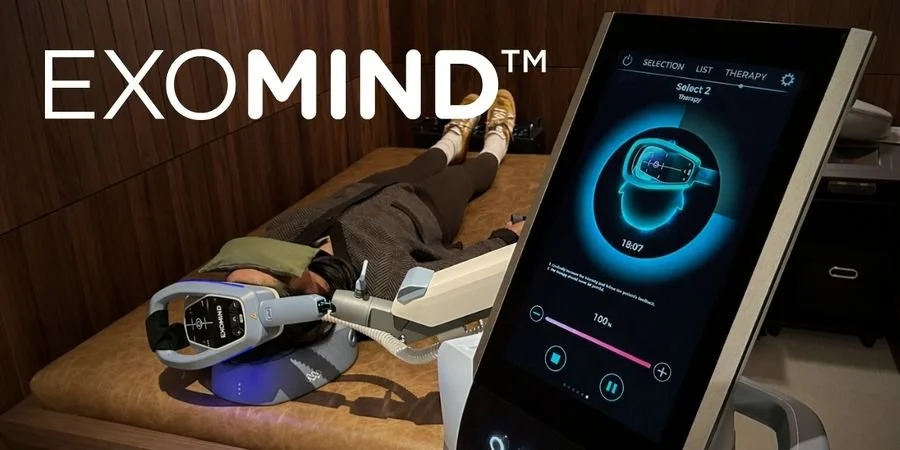
A client receives repetitive transcranial magnetic stimulation (rTMS) with ExoMind therapy, available at MATTR Biowellness Club in Austin, TX.
Understanding the Evidence of Transcranial Magnetic Stimulation
As science advances and we continue to explore new ways to support mind and body wellness in an increasingly stressful modern world, innovative technologies like ExoMind have emerged to help us stay healthy.
Supported by a growing library of research, this non-invasive brain wellness therapy has been shown to promote resilience, recovery, and overall well-being in a wide range of individuals. Continue reading to learn more about what ExoMind is and the benefits it provides, specifically how it is being used to support mental health and emotional balance.
What is ExoMind and how does it work?
ExoMind is a clinically backed technology that uses repetitive Transcranial Magnetic Stimulation (TMS)to gently stimulate specific brain regions and encourage healthier neural activity over time. In simpler terms, it involves placing a non-invasive coil against the scalp to deliver targeted electromagnetic pulses to the nerve cells inside the brain.
To understand why this is important, it helps to have a general knowledge of the central nervous system (CNS) and what it does. The CNS comprises the brain and spinal cord, along with the spinal nerves. As well as controlling everyday functions such as movement, speech, breathing, and digestion, the CNS regulates how we think, feel, and behave, making it critical to our mental wellness.
THE POWER OF NEUROPLASTICITY
Throughout life, the brain is continually adapting and responding to new experiences and outside stimuli. This process, known as neuroplasticity, is an important piece of the puzzle when it comes to understanding many mental health conditions. Knowing how the brain changes over time in response to our environment has opened the door to new therapies that are transforming how we approach rehabilitation.
How ExoMind benefits mental health
By enhancing natural brain signaling, ExoMind TMS technology promotes neuroplasticity in key areas of the brain—including those involved in attention, behavior, and mood regulation—to help support a more balanced emotional state.
A study published in 2025 points to ExoMind as a "promising approach" in enhancing mental well-being, with participants reporting improvements in mood, confidence, and mental energy as well as decreased feelings of stress, depression, and anxiety. Better sleep onset and quality was another reported benefit.
Additional studies focusing on specific mental health conditions such as anxiety and attention-deficit/hyperactivity disorder (ADHD) have also reported positive results.
decreases anxiety
Characterized by persistent feelings of fear or worry, anxiety disorders are the most common mental health concern in the United States and include generalized anxiety disorder (GAD) as well as panic disorder and specific phobias. Affecting more than 40 million adults, they can take a significant toll on overall wellness and quality of life.
This study focusing on adults with GAD notes that "participants receiving rTMS treatment showed a clinically significant decrease in reported anxiety symptoms." The findings offer hope for a safe, non-drug treatment for anxiety and align with similar studies like this one, which links rTMS with better outcomes for adults with panic disorder and major depression.
lowers symptoms of ADHD
Like anxiety disorders, ADHD affects millions of adults nationwide. Although often diagnosed in childhood, adult diagnoses of ADHD are becoming increasingly more common. ExoMind TMS treatment can provide positive benefits beyond the traditional treatment methods of medication and talk therapy.
In this analysis of completed trials on the benefits of transcranial magnetic stimulation therapy in adults with ADHD, researchers were able to determine that "TMS significantly improved the inattention, hyperactivity/impulsivity, and total symptom scores in ADHD patients."
improves sleep
Most Americans are not getting enough quality sleep, which many experts attribute to steadily increasing stress levels. By supporting healthy brain signaling and nervous system regulation, ExoMind may also help the body transition more easily into a restful sleep state. This is important because deep, restorative sleep enhances recovery, improves cognitive performance, and supports health and longevity.
This study of chronic insomnia (CI) patients shows rTMS treatment provided significant benefits in a short amount of time. During the two-week study, researchers targeted key areas of the brain involved in sleep regulation. In addition to improvements in sleep quality, they observed a "significant reduction in anxiety and depression among CI patients."
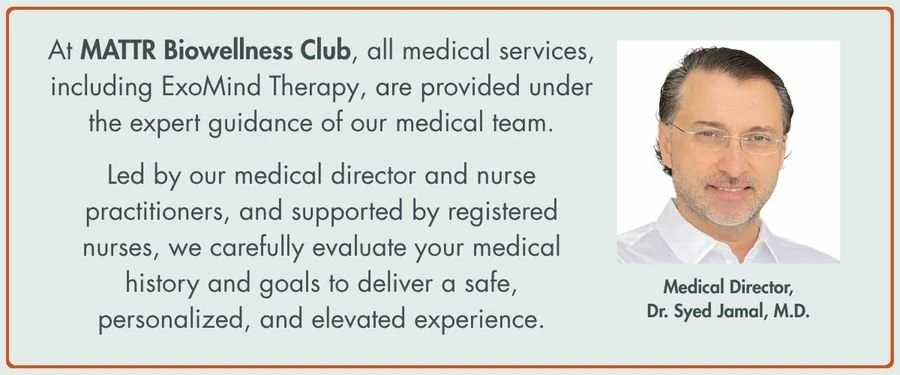
Experience ExoMind Therapy at MATTR
If you are feeling mentally overwhelmed or burned out, struggling with focus or mental clarity, or experiencing stress-related sleep disruptions, you may benefit from this non-invasive therapy. ExoMind is FDA-cleared for the treatment of major depressive disorder. Use for other conditions is at the discretion of your medical provider based on clinical judgment.
ExoMind is a 30-minute session that can be performed at any time during the day and requires no downtime, so you can return to your normal routine immediately following your session. Schedule your introductory consultation today at MATTR Biowellness Club in Austin to learn more about how ExoMind aligns with your individual health goals.